Tourist Accommodation Licence Requirements: Legal Guide
Discover tourist accommodation licence requirements: paperwork, certificates, and how to comply with regulations smoothly. Learn more and get started!
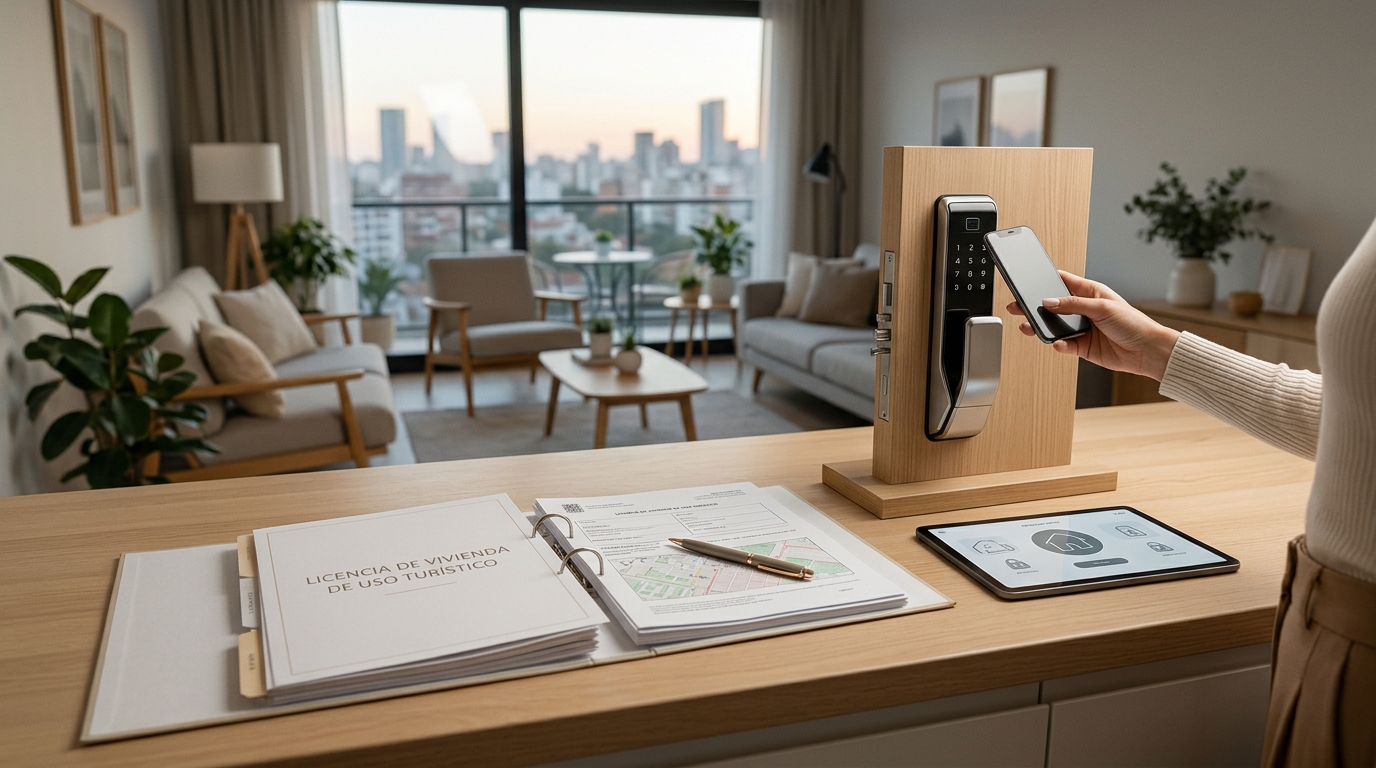
Opening a holiday home can feel like an endless bureaucratic maze, especially when every autonomous community and local council sets its own rules. However, being clear about tourist accommodation licence requirements (VUT) is the first and most important step to ensure your business runs without any legal hiccups. The good news is that, while procedures may vary, the key requirements and how technology can help you meet them follow common patterns across almost all of Spain.
Key Takeaways
- Regulations on tourist accommodations vary by autonomous community and, often, by municipality.
- Safety, habitability, and guest registration requirements are mandatory at the national level.
- A smart lock drastically simplifies regulatory compliance and daily accommodation management.
Tourist Accommodation Licence Requirements: Where to Start?
If you are planning to register a holiday let in 2026, the first step is the responsible declaration (declaración responsable). This document, submitted to the competent authority (usually the Tourism Department of your autonomous community), serves as your legal pledge that you meet all required tourist accommodation licence requirements. Signing it without fulfilling the regulations exposes you to substantial fines, making it vital to review every point thoroughly.
The Regulatory Maze
Always remember to consult the specific regulations of your autonomous community (Regional Tourism Decree) and, crucially, your local town hall's municipal ordinance, as many are restricting designated zones or imposing extra requirements such as independent street access.
First Occupancy Licence or Certificate of Habitability
One of the primary documents required is the first occupancy licence or, depending on your region, the certificate of habitability (cédula de habitabilidad). This document certifies that the property meets minimum living standards (ventilation, lighting, utilities, etc.). Without this, a tourist let licence is out of the question. Additionally, the property must be fully furnished and equipped for immediate use.
Energy Performance Certificate
Do not forget the energy performance certificate (EPC). It must be valid and, in most cases, officially registered. Tourism inspectors routinely check that the accommodation holds this certificate, which is also mandatory for renting or selling any residential property in Spain.
Technology as an Ally in Regulatory Compliance
Beyond the initial paperwork, the day-to-day operation of a tourist home brings ongoing legal obligations that hosts must fulfill. This is where process automation makes the difference between being tethered to your phone and running your business with complete peace of mind.

- Guest Registration Mandatory reporting of guest identities to law enforcement authorities.
- 24/7 Accessibility Enabling keyless entry without requiring the physical presence of the host.
- Occupancy Control Monitoring that the maximum capacity specified in the licence is not exceeded.
- Neighbourhood Relations Preventing disturbances (noise, parties) that could jeopardise the licence's continuity.
Guest Registration: Mandatory and Strict
Once your tourist accommodation licence requirements are in order and operations begin, you must comply with Royal Decree 933/2021 regarding guest identity registration. You must collect details from all guests aged 14 and older and submit them to law enforcement authorities (National Police, Civil Guard, Ertzaintza, or Mossos d'Esquadra) within 24 hours.
Handling this manually is tedious. Combining automated remote check-in software with ID and passport scanning ensures you comply with the law to the letter, dispatching guest registration forms automatically without manual intervention.
Access Management: The Physical Barrier
Town halls are increasingly strict regarding the arrival and departure logistics of tourist properties. Some demand independent access, and broadly speaking, causing disturbances in communal areas is heavily penalised. Handing over physical keys carries security liabilities (unauthorised duplicate keys, lost keys) and logistical headaches (waiting, delays).
Installing a smart lock for holiday rentals is the professional answer to this problem. Devices such as Raixer products allow opening both the main building door and the apartment door via smartphone or temporary access code. There are no keys to lose, and access rights expire precisely when the booking ends. This improves the guest experience while safeguarding property security.
The Building Entrance is Critical
Make sure the solution you choose can integrate street-level building entrance opening. The Raixer Intercom connects directly to the apartment intercom handset, allowing remote door release without modifying communal systems or bothering neighbours.
Steps to Obtain Your Tourist Licence (Without the Headache)
If the paperwork feels overwhelming, here is a general roadmap. Remember that specific timeframes and forms depend on your local town hall and autonomous community.
- Check the municipal ordinance. Verify that your property is not located in a saturated zone or under a moratorium, and that it satisfies local urban planning regulations (e.g., whether separate street-level access is required).
- Gather technical documentation. You will need the certificate of habitability (or first occupancy licence), the energy performance certificate, and floor plans.
- Review building community rules. Check the community statutes. If there is an express ban on tourist apartments, you cannot proceed. If there is not, informing the owners' association beforehand is often advisable.
- Submit the Responsible Declaration. Complete the form via the online tourism portal of your autonomous community, attaching all supporting documents.
- Register with the Police. Once you receive your tourism registration number (and display the official plaque at the door, if required), you must register on the police portal to submit guest registration logs.
Security and Comfort: The Future of Short-Term Rentals
As the sector matures in 2026, tourist accommodation licence requirements are moving toward higher standards of professionalisation. Authorities demand greater oversight, and neighbours expect minimal disruption. Regulatory compliance is not merely about avoiding fines; it is about building a sustainable business over the long run.
Devices like a noise monitor for holiday rentals complement smart locks, notifying you if sound levels exceed permitted thresholds and preventing neighbour complaints that could trigger licence revocation. Ultimately, smart technology turns burdensome requirements into automated safeguards that protect your investment.
Automating your tourist accommodation is not just a convenience for you; it is the most reliable and professional way to stay compliant with 2026 regulations.
Frequently Asked Questions
Is it mandatory to ask the building community for permission to open a tourist rental?
It depends on the community statutes. If they explicitly forbid short-term holiday rentals, you cannot open one. If they do not mention it, the Horizontal Property Law (Ley de Propiedad Horizontal) allows the community of owners to limit or condition tourist rentals (and even increase community fees by up to 20%) with a 3/5 majority vote, although this measure cannot be applied retroactively to properties already legally registered before the vote.
What happens if my local council requires independent street access?
This urban planning requirement is becoming increasingly common across major cities. If your flat is on an upper floor or accessed through a shared communal foyer, you will not be granted a licence in that municipality. This is why checking local ordinances before making any investment is critical.
Can I legally use smart locks in a holiday rental?
Yes, they are completely legal and highly recommended. In fact, they make it much easier to comply with guest registration laws and improve overall security by eliminating unmonitored physical key duplicates.
Do I need to put a plaque on my tourist rental's door?
In the vast majority of autonomous communities, yes. Once you submit the responsible declaration and obtain your registration number, displaying the official identification sign (VUT plaque) in a visible location at the entrance is mandatory.