How to Verify Guest Identity Before Granting Access
Discover how to verify guest identity before granting access to your accommodation to prevent fraud and comply with regulations. Protect your property today!
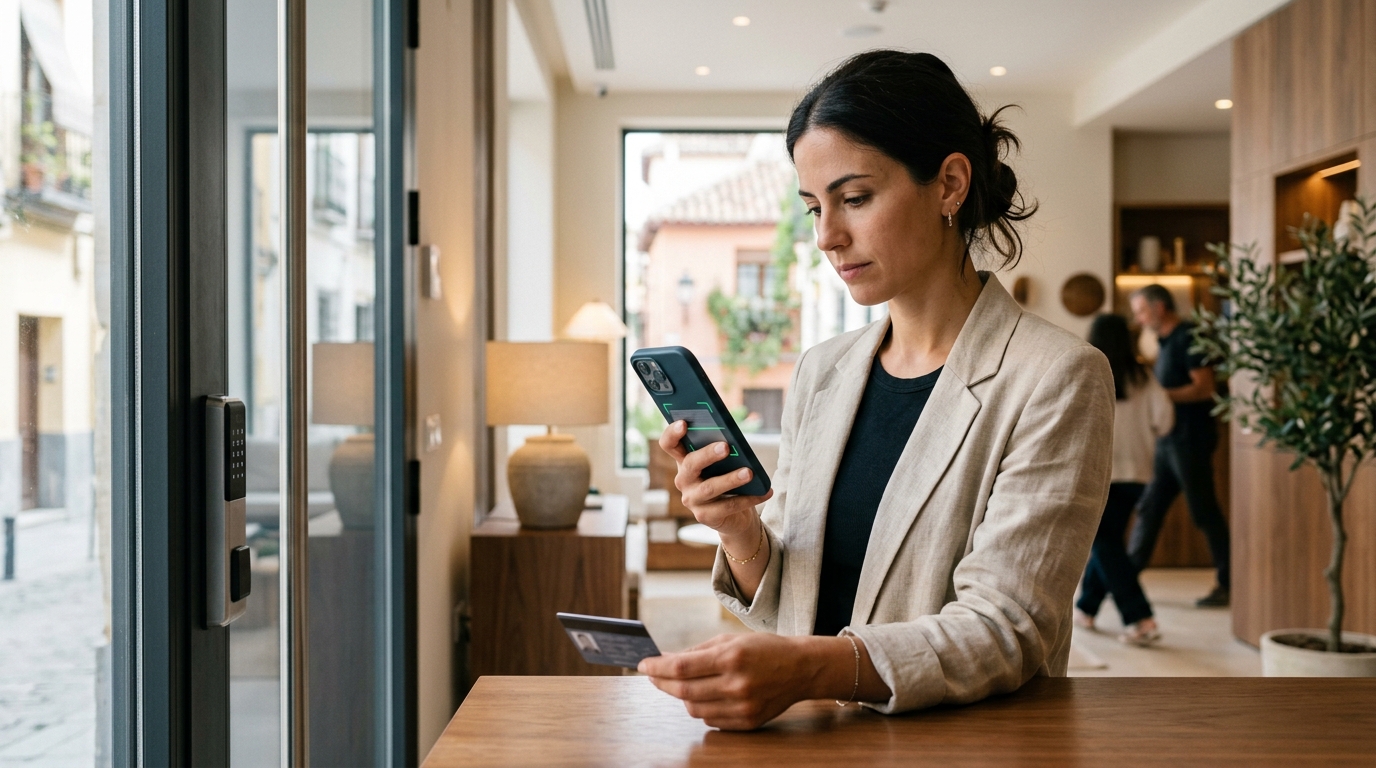
Handing over your property keys to a stranger without verifying their identity poses an unacceptable security risk and a potential legal headache. Learning how to verify guest identity before granting accommodation access allows you to protect your investment, comply with current regulations, and offer a completely autonomous arrival experience from minute one.
Key Takeaways
- Digital verification prevents fraud and protects your property prior to arrival.
- The online process combines Optical Character Recognition (OCR) and facial biometrics.
- Once the profile is validated, the system automatically releases physical access.
The Security Challenge: How to Verify Guest Identity Before Granting Accommodation Access
When you manage multiple properties or do not live in the same city as your holiday rental, meeting in person to inspect a passport or ID is no longer feasible. Knowing how to verify guest identity before granting accommodation access becomes the only barrier between a legitimate customer and an attempt at fraud, identity theft, or a fraudulent booking.
The digitalization of the hospitality industry in 2026 has standardized workflows where human contact is optional, but security is non-negotiable. It is not just about unlocking a door; it is about knowing with absolute certainty who is opening it. A robust verification system cross-references booking details with official documents in real time, blocking any access attempt if discrepancies arise.
- Fraud Prevention Avoid identity impersonation and payments made with stolen cards.
- Legal Compliance Streamlines the mandatory generation of guest registration reports.
- Neighbor Peace of Mind Ensures that the person on the reservation is the one actually staying.
- Preventative Filter Deters problematic profiles seeking anonymity.
Regulations and Guest Registration in 2026
The legal framework requires vacation rental managers and hoteliers to unequivocally identify every adult guest. This obligation entails collecting specific information from their identity document and submitting it to the competent authorities within a set timeframe after check-in.

Moving this step into the digital space does not eliminate the property owner's responsibility; it simply changes the format. Online verification tools must be capable of extracting the exact data required by law (first and last name, date of issue, document support number, and country) without transcription errors.
Data Protection
Make sure the platform you use encrypts document photos and complies with applicable privacy regulations. You should never store ID images on your personal smartphone.
Technologies Behind Online Validation
The magic of approving a guest in seconds comes down to two primary technologies: Optical Character Recognition (OCR) and biometric verification. When the guest clicks the link sent prior to arrival, the system activates their smartphone camera to scan their official ID.
OCR reads the alphanumeric fields and the MRZ code (the lines of machine-readable text at the bottom of passports). Immediately afterward, the guest is prompted for a "selfie" or a motion-based liveness test. Biometric algorithms compare the facial landmarks of the person in front of the camera with the photo printed on the identity document. If the match score clears the security threshold, the profile is marked as verified, seamlessly integrating into your automated remote check-in workflow.
Digital verification turns the guest's smartphone into the most secure front desk in the world.
Step-by-Step Guide to Integrating Verification with Access
Setting up this ecosystem requires connecting your property management system (PMS) with an identity validation module and, ultimately, with physical access control. It is a linked workflow that runs smoothly in the background.
- Sending the link. Days before arrival, the PMS automatically sends an email or SMS containing the registration link.
- Data capture. The guest scans their ID/Passport and captures their biometric photo.
- Profile validation. The verification system processes the data. If everything checks out, it approves the request.
- Generating the guest report. The collected data is sent automatically to the relevant authorities.
- Releasing access credentials. The door hardware receives the command to activate the temporary PIN or virtual key.
Connecting Digital Validation to Physical Hardware
Once you understand how to verify guest identity before granting accommodation access, the next link in the chain is the physical door. This is where smart devices come into play. Identity software cannot open a door unless it communicates with a lock designed to receive remote commands.
Modern devices operate using secure protocols. For example, via Wi-Fi connections or gateways, the lock receives confirmation that Guest "X" has been validated. At that exact moment, a unique PIN code is generated, valid exclusively for the dates and times of the booking. Systems like those integrated with Raixer allow identity verification to act as the trigger that unlocks entry permissions, operating under robust encryption standards (AES) and seamless communication.
Uninterrupted Access
If the system detects that the Wi-Fi drops, PIN credentials already stored locally in the lock's memory will continue to work, guaranteeing that the verified guest can always get in.
Benefits of Automating this Workflow for Your Holiday Rental
Offloading guest identification to a digital process eliminates friction and human error. You no longer have to juggle delayed flight schedules or wait for hours at the apartment door holding a clipboard. By deploying a smart lock for holiday rentals linked to an identity gateway, you bring a higher level of professionalism to your operations.
Furthermore, by requiring verification before sending any entry instructions or PIN codes, you guarantee that unauthorized individuals have no way of entering your property, drastically raising your overall security standards.
Frequently Asked Questions
What happens if the system rejects the guest's identity?
If biometrics fail or the document image is blurry, the process pauses. The system will prompt the user to retake the scan with better lighting or notify the property manager for manual review, temporarily withholding the access code.
Is it legal to require a facial photo (selfie) before arrival?
Yes, provided it is clearly stated in the booking terms and conditions, justified on security and fraud prevention grounds, and fully compliant with data protection laws governing the processing of biometric data.
Can guest identity be verified without an internet connection?
The verification process itself requires the guest's smartphone to have an active internet connection to upload images and compare them against security databases. However, once validated and the code is generated, the on-site lock can operate completely offline using technologies like Bluetooth (BLE) or locally stored PINs.
How is guest data sent to the police after validation?
High-quality digital check-in platforms feature direct API integrations with local or national police authority servers. As soon as the guest is verified and the reservation begins, the mandatory traveler log is generated and transmitted automatically.