Holiday Rental Regulations in the Valencian Community: Guide
Discover the key regulatory requirements for holiday rentals in the Valencian Community: licensing, registration, and management. Stay compliant and informed!
Running a holiday rental is profitable, but the red tape can turn into a real headache if you don't know where to start. Regulations for tourist rentals in the Valencian Community have tightened to ensure the activity is compatible with neighbourhood peace and public safety. Whether you are thinking about turning your property into a holiday rental, or you are already operating one and have questions about the latest changes, you need to know the registration, habitability, and community living requirements inside out.
Key Takeaways
- Registering the property in the Tourism Registry of the Comunitat Valenciana is mandatory before marketing it.
- An urban planning compatibility certificate (certificado de compatibilidad urbanística) issued by the relevant local council is required prior to listing the property.
- You must strictly comply with guest registration rules, reporting guest identities to law enforcement agencies.
What Qualifies as a Tourist Property in the Valencian Community?
Not just any flat rented out for short stays falls under the scope of Valencian Community holiday rental regulations. To be classified as a Dwelling for Tourist Use (VUT - Vivienda de Uso Turístico), it must be an entire, furnished, and equipped property ceded for tourist, holiday, or leisure purposes in exchange for a price. Regional legislation explicitly states that renting out individual rooms as holiday rentals is not permitted; you must rent the property as a whole.
Furthermore, this temporary transfer is characterised by marketing through tourist promotion channels. We are referring to platforms such as Airbnb, Booking.com, or real estate agencies. If you advertise your property through these channels, you fall squarely within the definition and are therefore obligated to comply with the law.
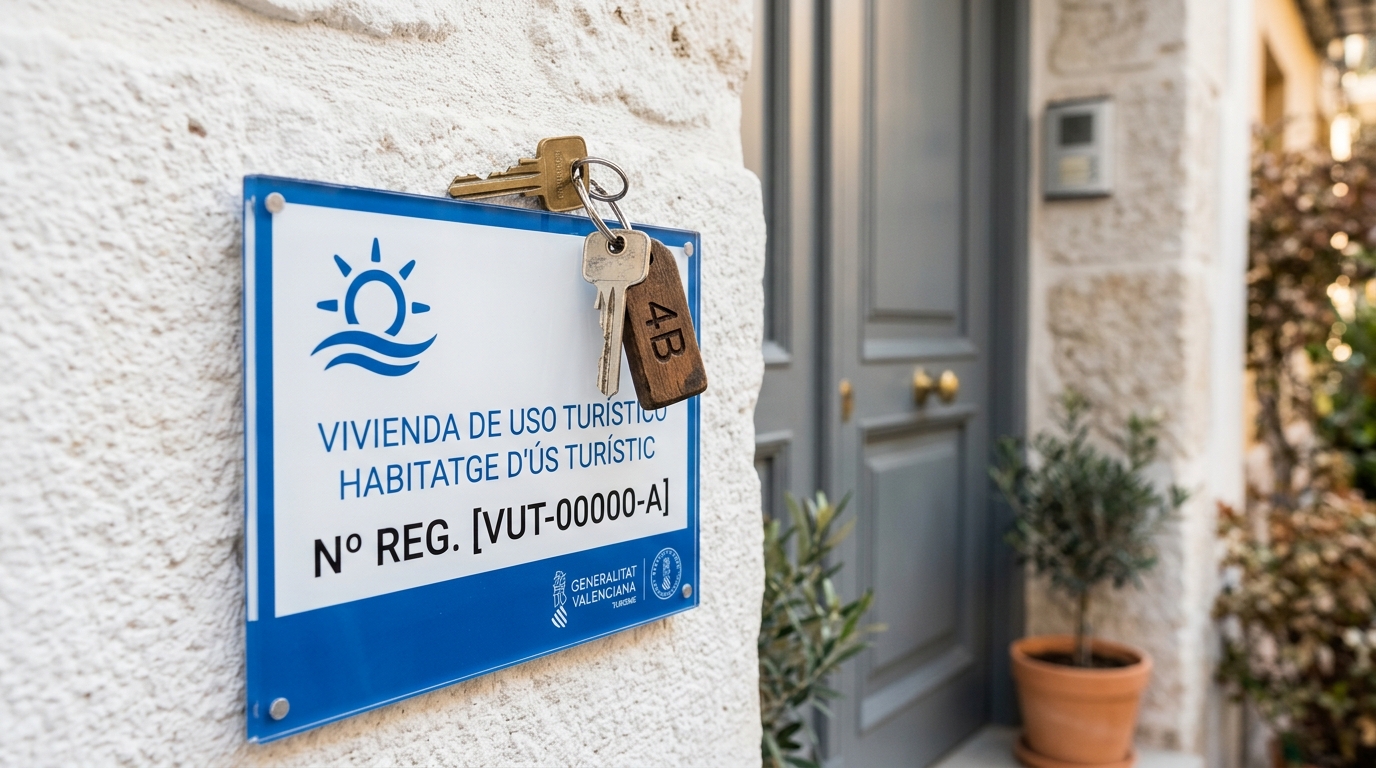
Identification Plaque
It is mandatory to display the official Dwelling for Tourist Use plaque in a visible location at the entrance to the property or building, showing the property's category and registration number.
Operational Obligations: Day-to-Day Rental Management
Having the flat registered is only the beginning. Holiday rental regulations impose strict day-to-day routines on property managers and owners. Skipping these procedures is not only illegal, but it also leaves you unprotected in the event of any guest incidents.

- Guest Registration (Parte de viajeros) You must verify the identity of all guests aged 14 and over and submit their details to the Police or Guardia Civil within 24 hours of check-in.
- Official Complaint Forms You must have official complaint forms (hojas de reclamaciones) available to guests, alongside a visible sign informing them of their availability.
- Public Liability Insurance Although specific terms can vary, holding third-party liability insurance to cover any damages to third parties is strongly recommended (and often indirectly required).
- 24/7 Availability You must provide a 24/7 contact telephone number to handle emergencies or complaints from neighbours promptly.
Technology to Simplify Regulatory Compliance
Managing paperwork and in-person obligations manually can eat up a significant portion of your profits in lost time. This is where technology becomes a property manager's greatest ally. Automating processes not only elevates the guest experience, but also guarantees ongoing legal compliance with minimal effort.
Guest registration, for instance, can be automated with apps that scan ID documents and submit the reports to law enforcement automatically. For arrivals and departures, installing a smart lock for tourist apartments (holiday rentals) eliminates the need for in-person key handovers. This is especially helpful when guests arrive late at night or face flight delays. By syncing these tools with PMS platforms, check-in turns into a seamless and secure routine.
To go the extra mile in preserving neighbourly relations, installing a noise monitor for holiday rentals lets you stay ahead of potential disturbances. These devices monitor decibel levels without recording conversations, sending alerts to your phone if guests exceed noise limits, thus safeguarding peace with the neighbours and avoiding noise fines.
The Accommodation Contract
Although you do not need to submit it to the tourism board, it is vital to have guests sign a contract or admission form stating dates, pricing, and, above all, house rules (such as no parties and quiet hours).
Taxation: How Tourist Rentals Are Taxed
Legal compliance doesn't end with the tourism department; the Tax Agency (Hacienda) also has a say. Income generated through holiday rentals must be declared, and how you do so depends on the services you provide.
If you simply hand over the keys, clean between stays, and provide bed linens, the income is treated as property investment income (rendimientos del capital inmobiliario) on your personal income tax return (IRPF). In this case, the activity is exempt from VAT (IVA), so you do not charge VAT to your guests. However, if you provide services typical of the hospitality industry (such as daily cleaning during the stay, catering, or laundry services), the activity is considered a business operation. Under this model, you must register under the appropriate business tax heading (IAE), charge VAT (usually at the reduced rate for hospitality), issue invoices, and file taxes as business income.
Frequently Asked Questions
Can I rent out just a single room to tourists in Valencia?
No. Current regulations in the Valencian Community do not permit tourist rentals on a room-by-room basis. A dwelling for tourist use must be leased in its entirety. If you rent out rooms, you must operate under the LAU (Urban Tenancies Act) for seasonal or long-term leases, not as a tourist holiday rental.
Is air conditioning mandatory?
It depends on the property category. Regulations require climate control systems (heating/cooling) in certain categories to ensure guest comfort. Review the specific technical requirements for the category under which you register your property to verify compliance.
What happens if my community of owners bans tourist flats after I'm already operating?
A ban approved by the homeowners' association (comunidad de propietarios) cannot be applied retroactively. If your property was already legally registered as a VUT before the community vote, you may continue your activity. The ban will only apply to new properties attempting to register afterwards.
How much does it cost to register a tourist rental property?
The registration process with the Tourism Registry of the Comunitat Valenciana is generally free of charge. However, you will need to cover the costs associated with obtaining the urban planning compatibility certificate (fees depend on the local council) and any other technical documentation required to update licences or certificates of habitability.
How can I make sure the local council will grant the compatibility certificate?
Before applying formally, consult your municipality's General Urban Master Plan (PGOU). Many town halls have zoned their areas, capping or freezing tourist licences in certain neighbourhoods (such as Ciutat Vella in Valencia). It is essential to check with the local urban planning department before making any investment.