Set the Right Price for Your Tourist Accommodation
Boost your tourist accommodation's profit with smart pricing strategies. Learn how to adapt to demand and avoid losing money with fixed prices. Maximize your bookings!

Many hosts, especially first-timers, will set a price for their tourist accommodation that they deem appropriate and then forget about it. This is the perfect formula to miss out on capturing the maximum benefit from your tourist accommodation. Remember that the idea is to get better bookings on Airbnb – not to always have your apartment fully booked!
[toc]
Fixed Prices Mean Losing Money on Your Holiday Rental
Let's imagine the case of Benicassim, a coastal town in Castellón, in eastern Spain. Simplifying, we have some key points about this town:
- High season in summer months and Easter
- Low season the rest of the year
- Peak demand from July 18th to 21st – dates of the FIB festival. The festival attracts 170,000 visitors.
And let's assume these three hosts.
- Host #1 will have a maximum occupancy rate and will have the accommodation booked several months in advance throughout the year. An inexperienced host might think they are doing well. However, the truth is that they are losing money because they could significantly increase their income during the summer.
- Host #2 will have a moderate occupancy rate throughout the year. But again, they will lose bookings during winter and will also fail to maximise income during high season.
- Host #3 will have a great high season because they will charge a higher price during the summer and will still be fully booked during those months. However, it will be empty the rest of the year because the accommodation price during winter is very high. The occupancy rate in winter will be very low.
In conclusion, none of these hosts are using smart strategies to price their tourist apartment to maximise the profitability of their accommodations. To adapt to demand, you need to adapt dynamic pricing throughout the year. Additionally, you need to consider which factors (such as the area and special events) impact the demand for your tourist accommodation.
What Factors Determine the Price of Your Tourist Accommodation?
The demand for tourist accommodation by guests in any city is determined by three main factors:
Seasonality
The demand for tourist accommodation is not constant throughout the year. Without a doubt, your area will have a high season and a low season for tourist accommodation.
The graph below shows the occupancy rates in 2018 for Nice, France. As you can see, demand is much higher in the summer months (July and August) compared to the lows of the winter months (November to January).
The peaks and troughs of each market are different. More touristy locations will have a greater difference between seasons – for example, coastal areas in Spain – compared to regions or areas with a higher proportion of business travel – for example, Madrid or Barcelona. The latter will show more constant demand curves over time.
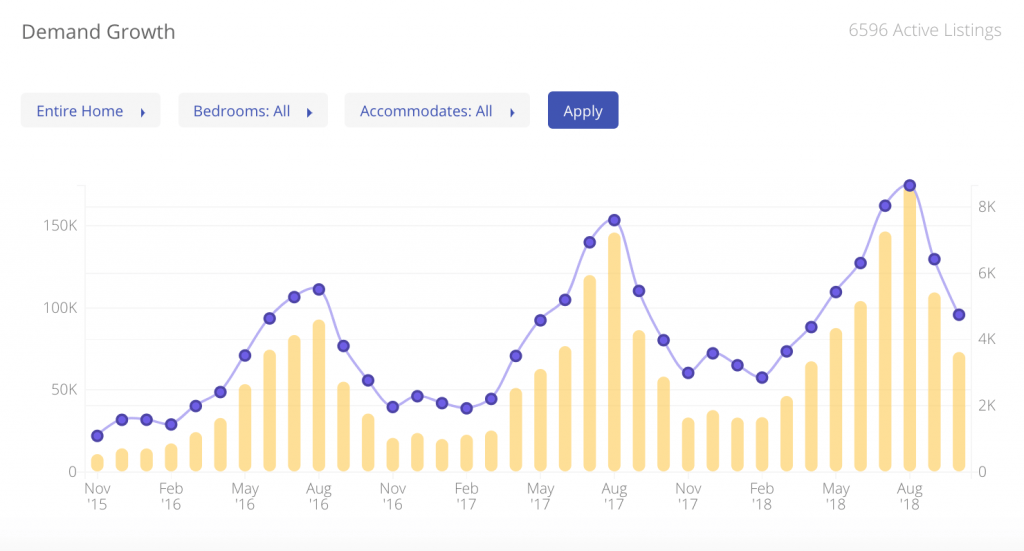
And even within the same city, different neighbourhoods will have different seasonalities. For example, areas near the beach will have more demand in summer than urban centres. Knowing which situation applies to your accommodation is the first step to setting a base price on which to apply Airbnb's smart pricing strategy or dynamic pricing.
If your tourist accommodation suffers from low demand, in this post we tell you how you can earn money with Airbnb during low season as well.
Day of the Week
Does your area attract more business travellers or more leisure tourists?
If most are business travellers, you will observe higher demand during weekdays rather than weekends. But this factor – which affects how to determine Airbnb's smart pricing – is hyper-local. It not only varies from city to city, but it also varies depending on the neighbourhood within the same city.
Think about the case of Madrid.
The neighbourhoods of Letras, Cortes, or Justicia will have higher demand on weekends – they are in the city centre and very close to tourist attractions. While other more peripheral neighbourhoods such as Plaza Castilla, Cuzco, or Las Tablas – with a high concentration of offices and businesses – will tend to have higher demand during the week.
Use this information to influence Airbnb's smart prices: dynamic prices will vary depending on the day of the week the booking is made. This is closely related to how to position your tourist accommodation.
Special Events
Airbnb's dynamic pricing will also be affected by special events in the area. For example, large trade fairs or sporting events will cause demand to skyrocket in a very short period of time.
Again, the impact is geographically limited – usually to a few kilometres around. As guests want to be as close as possible to that event.
Let's think again about the case of Madrid. At the end of last year, with barely ten days' notice, it was announced that the Copa Libertadores would be played in Madrid, instead of Argentina. Accommodations in the Spanish capital registered 79.5% occupancy, which is 5 percentage points more than last year, when 75% was recorded, according to HOSTELTUR.
During these events, hosts can multiply their regular prices by 2 or 3. Simply knowing when a major event will occur in your area is not enough to determine how much you need to adjust Airbnb's smart price. Continue reading to learn how to do it.
Cleaning Fees
Intelligently using Airbnb cleaning fees is key to maximising the profitability of your business. In fact, you can use them to incentivise certain types of bookings. We explain it with some examples:
- By setting high Airbnb cleaning fees, you will discourage short stays. Why? Because cleaning fees are a fixed charge (regardless of the number of nights), and therefore will make the nightly price of your accommodation more expensive.
- If you choose low Airbnb cleaning fees, you will incentivise bookings for a few nights – which normally involve higher costs for the host (more check-ins). But of course, you will get more bookings and reviews – and this may be your goal if you are starting out.
How to Use Your Tourist Accommodation Price to Increase Your Bookings
If you have enough data, look back at your booking calendar. You see that you have close to 100% occupancy this year. Or that you have managed to have the highest nightly price throughout the year.
Have you then optimised the profitability of your tourist accommodation? Probably not.
Low Price and Very High Occupancy
This is a very common mistake among new hosts. They usually focus too much on achieving and maintaining a very high occupancy rate.
It is reassuring to see that your tourist accommodation has been booked at lightning speed months in advance. After all, it seems like you are doing well with the competition on Airbnb because there are barely any free nights.
The problem is that this intuition is incorrect. You are probably not earning as much as you could.
Having a very high occupancy rate more than 4 weeks in advance means that the price of tourist accommodation is very low.
And this way you are missing out on earning money. Look at an example:
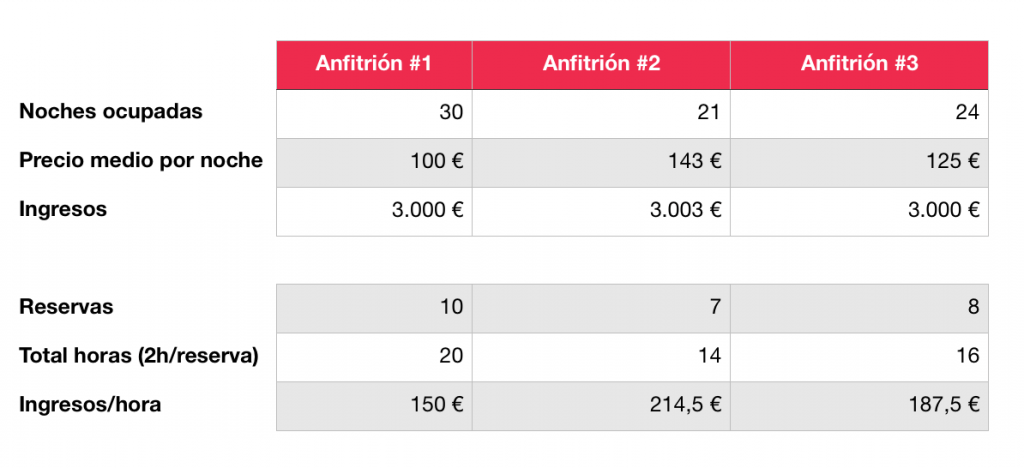
In this case, we have three hosts who are earning the same amount of money monthly for their apartment. We will assume, for simplicity, an average of 3 nights per stay; and that each host dedicates 2 hours of work each time there is a booking. That time would include cleaning the Airbnb, check-in and check-out, responding to hosts, etc.
If we only look at the Revenue row, we see that in all three cases they are earning about €3,000/month. However, when we include the time factor – the Hours column – we see that Host #2, who has the fewest bookings (7), is making better use of their time (€214.5/hour).
The problem with being 100% occupied is that you don't know when you could have charged more and still maintained the same occupancy rate. Let's go back to the table example. If Host #1 raised the tourist apartment price to €125/night, then they would be losing out on €750/month. If they set the same price as Host #2, €143/night, then... they would be losing out on €1,300/month!
The key is that 100% occupancy more than a month in advance is a mistake. You should try – even if you have a few unbooked nights – to increase your price until you find the optimal occupancy rate.
High Price and Irregular Occupancy Rate
Another common mistake among new hosts is to focus exclusively on maintaining a high tourist apartment price – the highest possible – throughout the year.
Let's see why this is a mistake with an example:
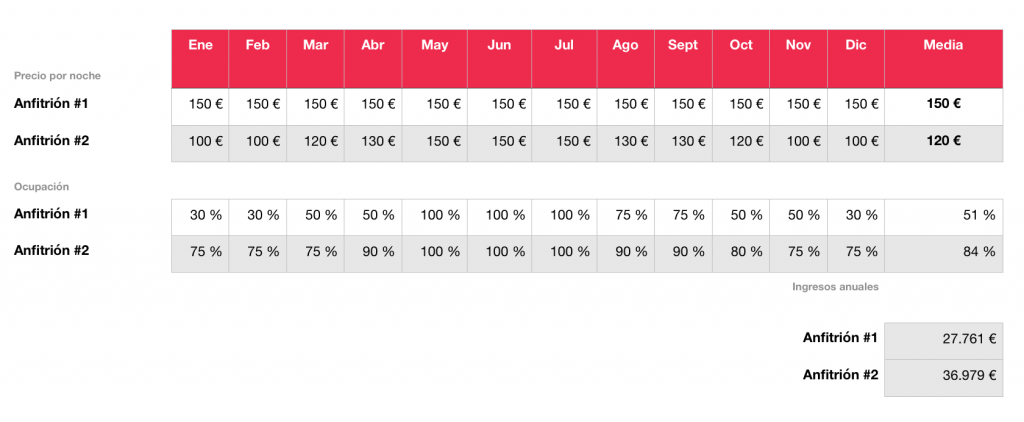
Host #1 maintains the tourist accommodation price at €150/night throughout the year. While Host #2 tries to balance the tourist apartment price with a higher occupancy rate.
As you can see, even when Host #1 has a price of €150, much higher than Host #2 (with an average of €120), the occupancy rate in months with less demand negatively affects the first host's income. Keep in mind that the goal is not to get more bookings on Airbnb, but better ones.
By reducing the price of the tourist accommodation during the bad months, Host #2 achieves higher income by the end of the year.
The Tourist Apartment Price and its Occupancy Rate Must Be Balanced
The tourist apartment price and the occupancy rate are the most important levers hosts have at their disposal. You should not waste them. Use them to improve the profitability of your Airbnb.
Finally, if you want to start using the tourist accommodation price to maximize your bookings, you should take a look at these Airbnb pricing tools and download for free the Airbnb financial calculator – to be able to make these estimates with your own data.

The 9 Biggest Mistakes When Pricing Your Tourist Accommodation
Have you chosen a price for your Airbnb and left it that way since you started? That is often the main mistake of first-time hosts. If you are not regularly adjusting your prices (for example, twice a month) based on the season, special events, or your competition... you are making pricing mistakes in tourist accommodations.
Not Using Automated Pricing
There are Airbnb pricing tools that can help you achieve up to 40% more income. These software use algorithms that detect changes in nearby competition – and demand! – and assign the appropriate price to optimise your occupancy rate and maximise your profitability.
The programs usually include a series of factors, such as:
- Special events
- Weekends vs. weekdays
- How much time is left until the booking date
- Seasonality
- Price of nearby hotels
- Price of your competitors
- Occupancy rate
This will help you avoid the pricing mistakes in tourist accommodations that we will discuss below.
Setting a Very High Price at the Beginning of the Activity.
If you are starting your activity, do not try to set the desired target price immediately. The smartest way to avoid mistakes is to set your nightly price below your competition. This way you will get your first booking sooner.
When you are just starting with your tourist accommodation, you have little credibility – and no host reviews! Therefore, it becomes difficult to compete with other Airbnbs with hundreds of ratings.
Setting a Very Low Price When You Already Have Experience
Once you have received several reviews, you should increase your price to match that of your competitors.
While having a full calendar 4 months in advance may seem great... The truth is that a high occupancy rate so far in advance means you are leaving money on the table. A clear pricing error in tourist accommodations.
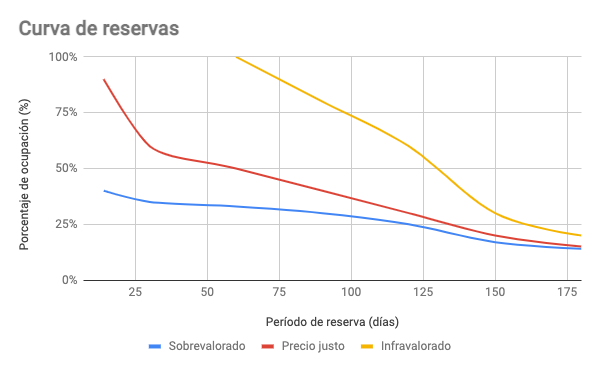
The golden rule is to have 75-90% booked 2-4 weeks in advance but only 50% booked 8-10 weeks in advance.
Setting the Same Price for Weekdays and Weekends
If your Airbnb price is the same for weekdays and weekends... you are not doing it right.
Take a look at what happens with nightly prices in hotels. Aren't they higher on weekends?
The reason is that demand is higher during those days.
Not Considering Seasonality
In any area – except the most touristy ones – there are usually variations in accommodation demand throughout the year.
Knowing well when it is high or low season can help you adjust the price and avoid this very common mistake: having a very high price in low season (or very low in high season) will crush the profitability of your business.
Not Considering Special Events
Very popular special events are usually organised well in advance. Take a look at your local calendar and mark the days with sporting events, concerts, or trade fairs.
Bookings during those days usually become much more expensive. If you do not take these events into account, you will be making a serious pricing error in tourist accommodations.
Entering a Price War
Entering a price war can be the end of your tourist accommodation. You might initially think that the best idea is to always keep prices lower than your competition, but beware! you may encounter several traps if you don't fully understand what a price war consists of.
Entering such a battle means lowering the prices of your tourist accommodation compared to the competition. What's the problem? That it's possible for someone from the competition to use the same strategy as you. And in the end, you end up with a very low price, with very little profit margin. That is, you and your competitors will end up in a vicious cycle:
- You lower prices
- Your competition imitates you
- You try to outdo them
- And so on... until profitability suffers
Quality Trap
Quality is something a lot of people consider when choosing accommodation for their holidays. It is precisely for that reason, they are on holiday, they want all possible comforts without worrying about anything and enjoy a quality place.
The problem arises from the premise that we tend to identify lower-priced accommodations with poorer quality. A potential customer will ask: “Why is this accommodation so cheap, where's the catch?”. They might think the beds won't be good, that the accommodation isn't well located, or any other potential flaw.
Or in other words, just like in other areas such as fashion, we tend to think that expensive things are of higher quality. This may not be the case, but if you enter a price war with accommodations in your area, you might end up driving away potential customers just by having a lower price.
There are healthier ways to compete in the holiday rental sector than entering a price war with your competition.
Loyalty Trap
Let's consider the situation where you lower the price of your accommodation compared to the competition in order to get more bookings. Initially, it may seem good, the problem is that you will attract a clientele that is impossible to retain.
People looking for cheap accommodation do not usually take into account all the amenities offered, but simply focus on the price. If that clientele wants to stay in that area again, when searching they will look for the cheapest accommodation again, whether it is yours or not. In other words, despite having stayed in your tourist accommodation, if there is a better offer, they will take it.
Price-based positioning has this great danger: it attracts people who, when travelling, are only looking for something economical and, therefore, cannot be retained. Do not underestimate occasional offers, but the exercise of finding your target customer should be the first thing you do.
Now that you better understand what a price war consists of and its consequences, we can talk about the biggest problem or the biggest trap of all.
If you lower the price of your tourist accommodation, you will have a lower profit margin, making your apartment less profitable. For this reason, the moment your bookings slightly decrease, you may not even cover your operating costs and your accommodation will cease to be profitable.
Furthermore, an accommodation in your area with similar characteristics that is positioned by quality instead of price, will obtain a greater profit with the same number of bookings. Therefore, holiday accommodation positioned by quality will have more chances of surviving changes in demand.
Thus, if activity decreases a little during a tourist season, by having your accommodation positioned by price, your profits will be much more sensitive to this change. For the same reason, if demand increased, your profits would not increase significantly either.
Pricing Tools for Tourist Apartments
Below you will read a comparison of pricing tools for tourist apartments. They will help you know how much to charge per night on Airbnb based on the different factors that affect the price.
Are you one of those hosts who always charges the same? Remember seasonal changes (high, low, medium); the number of nights; or the existence of special events in your area.
Further down you will find the comparison of specific software. However, first let's understand what benefits they have and what are the theoretical bases for how these tools work to set dynamic prices in your tourist accommodation.
Advantages of Airbnb Pricing Tools
A good pricing tool for tourist accommodations uses a large amount of real-time data to optimise the price you should charge per night.
Here are some reasons why this type of software for setting prices on Airbnb is the most effective way to increase the profitability of your business:
- They give you a real picture of the demand in your market; and in your neighbourhood! Demand is the main KPI of your business. It is the number that increases your bookings and earnings. Your Airbnb prices should reflect how much your customers are willing to pay. And that should include the effect of local events or the seasonality of your area.
- Different prices for each night: We have some times talked about how much to charge on Airbnb per night. A Saturday is not the same as a Thursday; and a Saturday in February should not be the same as a Saturday during the August bank holiday.
- Automatic price updates throughout the year: All Airbnb pricing tools allow you to calculate and update prices for each day. Throughout the year. This way you can optimise the profitability of your accommodation.
- Analyse your performance against the market: Since these Airbnb pricing software include market data, you will know how well or poorly your accommodation is doing compared to the competition.
- It allows you to plan and make accurate forecasts: this way you can know what income to expect – and how to earn money with Airbnb during low season too!
How Pricing Tools for Tourist Accommodations Work
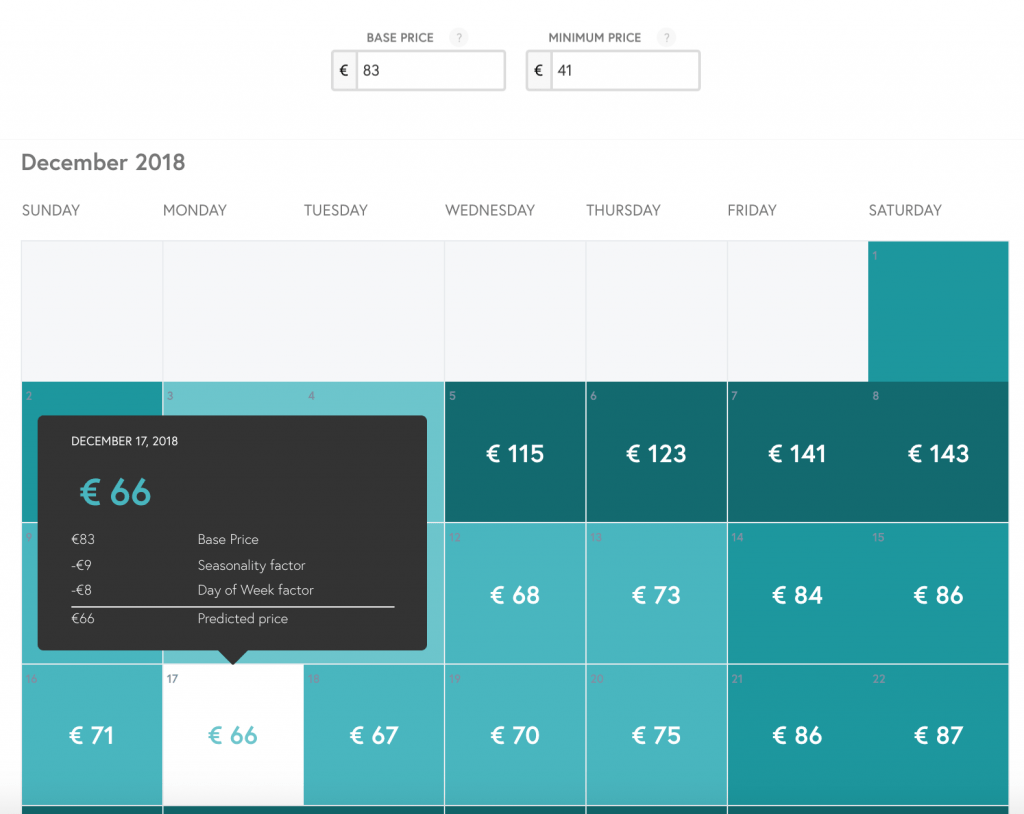
The operation of pricing tools for Airbnb is very similar. First, you must set a base price – the standard you charge per night –; add a minimum price – what you would charge in low season –; and then let the software determine the percentage increases and decreases according to seasonality, events, day of the week, etc.
How They Determine the Base Price of Your Accommodation
Setting the correct base price for your accommodation is key to maximising profitability. Normally, it is the first data you must enter when using this Airbnb pricing software. As it is the figure from which they start to recalculate the price for the rest of the days.
The definition of base price is the average of what you have charged per night for your accommodation.
If you are an experienced host, this is really simple to calculate. You just need to calculate the average price at which you have received bookings. For example, if your nightly price in high season is €200, and in low season it is €150; the base price is €175. If you only have a weekday price and a weekend price, it will be the average of those two.
If you are starting with your accommodation and have no bookings, you will have to find accommodations similar to yours (same quality, same number of rooms) that have around 50-80% of the next month booked. Your base price will be slightly lower – deduct 15-20% – from that average until you get your first 3 or 4 bookings and your first review.
Once you have correctly set the base price, monitor how your accommodation performs against the ideal booking curve. This will help you know if it is booking too fast (and therefore the base price is too low); too slow (your base price is high); or at the right speed.
When Should You Change the Base Price in Pricing Tools for Tourist Accommodations?
Once you have set your base price for your accommodation, we are ready to start. The next step is to check how your bookings are doing at that nightly base price to determine if it is correct or if you need to make some adjustments. These Airbnb pricing tools compare your statistics with those of your listing and compare them with the model.
For example, they usually include:
- Your current nightly prices
- Percentage of nights booked in the next 30 days
- Percentage of nights booked in the next 60 days
- Percentage of nights booked in the next 90 days
This percentage of nights is reviewed across several time horizons to balance the model. For example, if you are overbooked in the next 45 days but underbooked in the next 90 days, it is balanced. This is an index that will be used to take action.
Depending on how booked your accommodation is at the base price we have set, we should adjust it weekly. For example, if your percentage of booked nights is slightly high, you should increase your base price a little – try increasing it by 5% –. If, on the other hand, your percentage of booked nights is very low, reduce your base price by 15-20% until bookings start coming in.
Let's use an extreme case to better understand how the base price adjustment works in Airbnb pricing tools. Imagine your accommodation is 100% booked for the next 60 days. In that case, you should significantly increase your base price. You can take a look at this table to see how much you should raise or lower it:
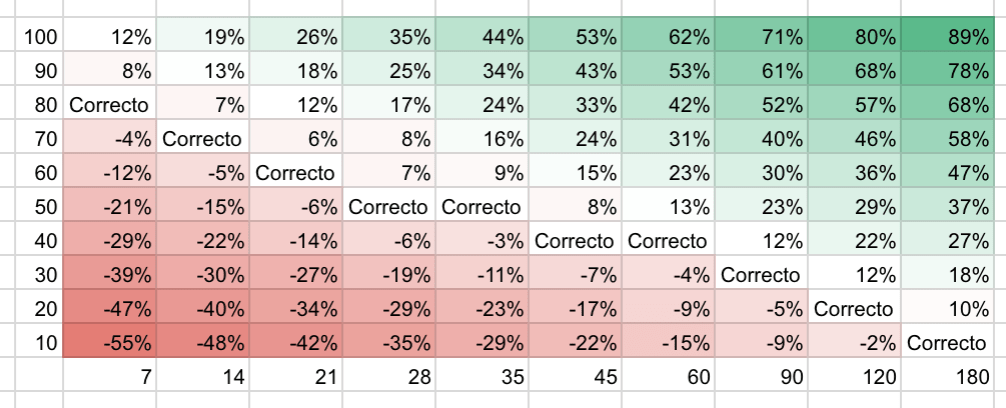
💡Why is 100% booked not optimal? If your accommodation is always 100% booked, it means you are leaving money on the table. Revenue management for Airbnb is a combination of percentage of nights booked and prices. For example, it is better to be 90% booked for the month at €200 per night than 100% booked at €175 per night (€200 x 30 nights x 90% = €5,300 vs €175 x 30 x 100% = €5,250).
Once your base price is correctly determined, it's time to let your chosen Airbnb pricing tool make the necessary adjustments based on its model's variables.
Comparison of Pricing Software for Holiday Rentals
It is true that there is a wide variety of pricing software for holiday rentals. However, not all have coverage in Spain or Latin America. The tools we mention here do!
Airbnb's Price Estimator
Airbnb will suggest a price for your Airbnb based on the information you have provided (such as the city, the number of available rooms, or the type of accommodation) as well as additional environmental information (average prices of similar accommodations, historical price trends, etc.).
You can play with the price estimator that Airbnb offers you. You can use it as a basis for setting the final price for your accommodation. However, you should adapt it to your circumstances. If it's your first Airbnb accommodation, as is likely the case, consider lowering your average price. In this sense, it is advisable to search your area for similar accommodations and personally decide the price to include.
However, Airbnb integrated dynamic pricing into its own platform in June 2018. The tourist accommodation platform must have the best data collection of all services. Mainly, because it controls both supply and demand. Discover how smart pricing works and how to activate it in Airbnb's help.
Airbnb's smart pricing tool is completely free for hosts on the platform.
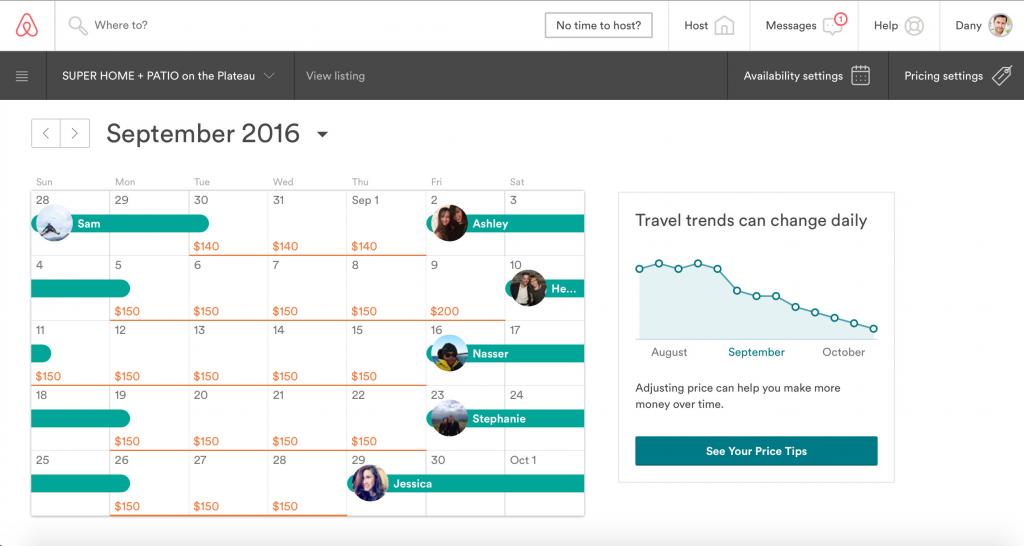
Airbnb's smart pricing is a strategy that involves changing the nightly price of your accommodation when there are changes in the supply and demand of your market. Is this something that happens in your neighbourhood? Absolutely! Keep reading to find out how they do it.
Changes in supply come from adding more and more tourist accommodations to certain markets. Greater supply means greater competition and, therefore, less power to set high prices. For example, in the city of Madrid, the annual growth in the number of Airbnb accommodations has been 58% since 2010. In the same city, the number of accommodations increased from 39,040 in 2017 to 50,120 in 2018.
😱Seriously! If you're not using Airbnb's smart pricing, you're losing money.
Wheelhouse
Wheelhouse is compatible with Airbnb, Homeaway, VRBO. Furthermore, it is available in several cities, including some in Spain and Latin America.
The price is 1% of automated bookings if you have fewer than 10 properties. For property managers or tourist apartment managers with more than 10 properties, Wheelhouse charges 0.75%.
https://www.youtube.com/watch?v=vgSZXn3nM0s
Pricelabs
Pricelabs is another Airbnb pricing tool available in Europe. Unlike other alternatives, Pricelabs charges from $19.99 per automated accommodation.
https://youtu.be/cpem_nBhuAw
Beyond Pricing
Finally, Beyond Pricing is another Airbnb pricing software. Available in Europe and some Latin American cities. It charges from 1% of automated bookings.
https://youtu.be/MFTHwoDWRF4
🔔 Did you like this article about Airbnb pricing tools? Sign up for the Raixer newsletter and receive practical tips to increase bookings for your tourist accommodation. Additionally, if you want to save time and money on guest key handover, you can purchase the Raixer Intercom smart lock.